
Graphic Design
![[NEEDS REVIEW] Likely a Farm-to-School Procurement project photo based on file grouping (could not preview image)](https://cdn.prod.website-files.com/6422638f3a9a322ac607f3a8/642d16035fb1be1b0846ba44_IMG_4202.JPG)
Friends & Family (V1)
![[NEEDS REVIEW] Likely a Farm-to-School Procurement project photo based on file grouping (could not preview image)](https://cdn.prod.website-files.com/6422638f3a9a322ac607f3a8/642d17ae6e06ee774bc0bb6e_IMG_4207.jpg)
Usability test (V2) (PDF design system guide integration)
![[NEEDS REVIEW] Likely a Farm-to-School Procurement project photo based on file grouping (could not preview image)](https://cdn.prod.website-files.com/6422638f3a9a322ac607f3a8/642d17bdab70ee98b5fc8b64_IMG_4237.JPG)
MVP1 Broad Market Release (Design system + legal approval) (V3)
![[NEEDS REVIEW] Likely a Farm-to-School Procurement project photo based on file grouping (could not preview image)](https://cdn.prod.website-files.com/6422638f3a9a322ac607f3a8/642d181a651b71298371a914_IMG_4302.JPG)
MVP1 Broad Market Release (Design system + legal approval) (V3)
Photography
Our team needed to deliver a presentation, pictorial, and two-minute video within a month's timeline focusing on the systemic and social issues surrounding various NGOs from our choosing. We gravitated towards Farm to School, particularly due to their values and network to advocate for education, procurement, and school gardening. We also felt as a team that we would have more access to potential research participants in Indiana to aid the cause of this NGO
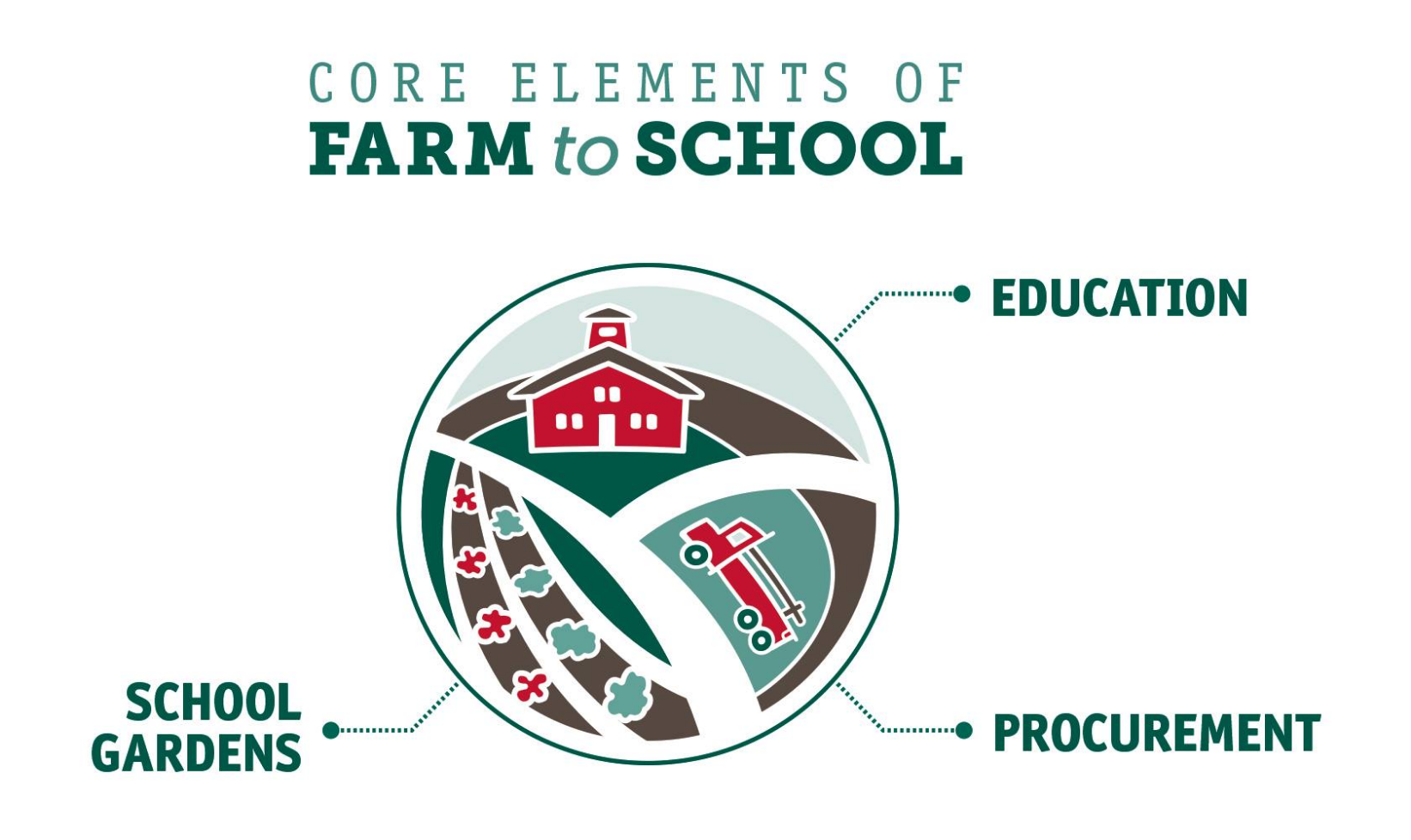
We felt our strengths and interests best aligned with focusing on the procurement process for schools from local farmers and larger-networked farms.
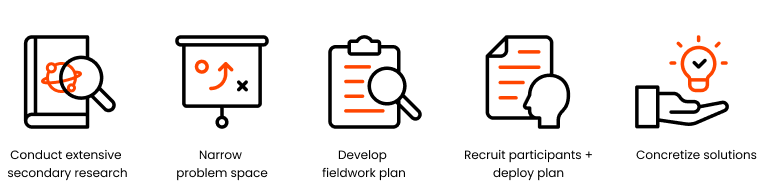
Our extensive secondary research illuminated six key stakeholders: teachers and staff, community members, students, processors, partners and families, and farmers. Focusing our stakeholder groups of farmers and schools, we worked to understand the problem from each angle, including where the problems overlap.
Our extensive secondary research illuminated six key stakeholders: teachers and staff, community members, students, processors, partners and families, and farmers. Focusing our stakeholder groups of farmers and schools, we worked to understand the problem from each angle, including where the problems overlap.
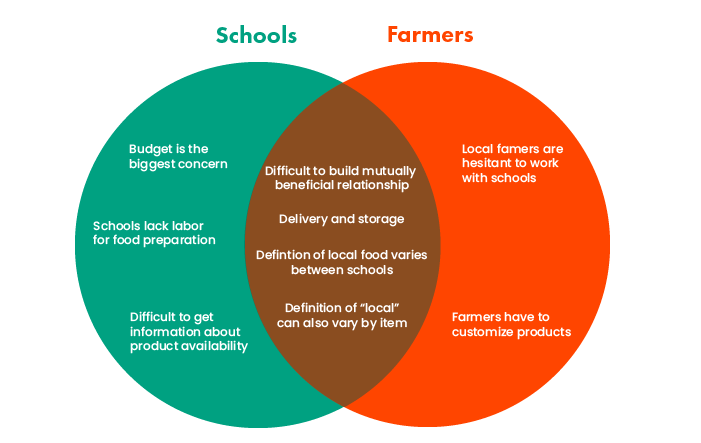
This narrowing of key problems and stakeholders allowed us to align our goals of the project with two key goals of the NGO Farm to School:
• Work with pilot schools to help their foodservice buy, menu, and prepare local foods"
• Offer trainings and standard operating procedures on how to properly procure local foods"
[http://www.farmtoschool.org/our-network/Indiana]
Fieldwork Plan
Our primary objectives focused on learning specifics from local farms and schools about how the procurement agreement takes place and how relationships are initially formed between farms and schools.
We constructed a plan to collect primarily qualitative data through semi-structured interviews, cognitive mapping workshops, and fantasy workshops. For participants, we focused on recruitment via email, clarifying our roles on the project and asking for potential interest from local farmers and schools. We were graduate students at a reputable college (Indiana University Bloomington) and didn't provide incentives in fear of biasing the data with affirmation in search of reward rather than honest answers. Our goal was to recruit at least one school and farm.
Our data collection methods included note taking, audio recording, picture taking, on-site mapping, and on-site card creation using the tools of pen and paper, phone cameras, and smartphone recording in addition to pre-prepared materials such as the "What If" cards for the fantasy workshop.
We constructed a plan to collect primarily qualitative data through semi-structured interviews, cognitive mapping workshops, and fantasy workshops. For participants, we focused on recruitment via email, clarifying our roles on the project and asking for potential interest from local farmers and schools. We were graduate students at a reputable college (Indiana University Bloomington) and didn't provide incentives in fear of biasing the data with affirmation in search of reward rather than honest answers. Our goal was to recruit at least one school and farm.
Our data collection methods included note taking, audio recording, picture taking, on-site mapping, and on-site card creation using the tools of pen and paper, phone cameras, and smartphone recording in addition to pre-prepared materials such as the "What If" cards for the fantasy workshop.
Research
Recruitment
Following our research plan, we emailed several Indiana schools and farms to hopefully receive a response in the timeframe of one week. One local farm, two local school system representatives at separate schools, and one Farm to School network representative agreed to help us with our research, thus giving us three field sites and one remote field site to work with.
Interviews + Workshops
To supplement our semi-structured interviews deployed with each of the five participants, we constructed one cognitive mapping workshop we deployed at the farm site and one fantasy workshop with a local school representative.
Conducting our cognitive mapping workshop with a local farm, we found that the process of procurement for their farm ecosystem constrained specifically towards experimentation and customer feedback. Another recurring theme stemmed from education of crops and typology versus customer expectations of those crops.
The most key theme of the procurement process for this farm centered around community, drawing our attention to their involvement with local events, volunteering, and other local farming communities.
Conducting our cognitive mapping workshop with a local farm, we found that the process of procurement for their farm ecosystem constrained specifically towards experimentation and customer feedback. Another recurring theme stemmed from education of crops and typology versus customer expectations of those crops.
The most key theme of the procurement process for this farm centered around community, drawing our attention to their involvement with local events, volunteering, and other local farming communities.
At each school field site, both local Bloomington schools, we deployed a fantasy workshop involving "What If?" cards in order to prompt new design ideas through a co-design session. This generative tool allowed us to construct and understand new insights without simply asking questions as in our supplementary semi-structured interview questions.
Design insights
Following each of our research deployment sessions, we generated a combination of notes, recordings, pictures, and audio recordings. After parsing through each of them, we developed nine key insights to design around:
Narrowing our focus for our final design conceptualization stage, we chose to specifically focus on the bolded insights.
Narrowing our focus for our final design conceptualization stage, we chose to specifically focus on the bolded insights.
- Relationship management: connecting and maintaining relationships between local farmers and schools
- Assumption of needs / perceptual barriers: specific logistics like quantity of produce required/ able to be provided are assumed by both sides
- Interest farmers in Farm to School: provide direct information and benefit to introduce and recruit farmers to the Farm to School program
- Food processing post-procurement: cleaning and maintaining the freshness of food and the responsibility of the schools and / or farmers towards this end.
- Develop lasting trust between schools and farms: What happens when a farm's produce or crops fails to grow for a season? What back-up plans can be created for both farms and schools?
- Piazza Produce currently works well for schools: schools are able to find locally-sourced foods at transparent prices with abundant produce amounts
- Personal relationships (and secondary contacts) influence the procurement process: schools procure from those whom they trust and rely on contacts to assist them in the procurement process
- Additional funds may be available to initiate the Farm to School program: money is a continuous and perhaps most constraining aspect of the procurement process for both farms and schools
- Most of the work for our NGO is voluntary: this relies heavily on the interest and motivation of volunteer workers who may already have additional resource and time constraints in their lives.
Design Proposals
Design Concepts
After a few rounds of rapid ideation, we solidified five design concepts that we wanted to proceed and test with another fantasy workshop. Each concept sought to address a specific design insight we gathered or combination of insights that could directly develop a solid relationship between local farmers and Farm to School. We created a storyboard for each of our design concepts to showcase in the form of "What If" cards in our fantasy workshop. Our motivation to use a fantasy workshop to receive feedback stemmed from the concepts not being fully conceptualized and having lower-fidelity looking "What If" cards allowed our participant to more readily critique our given designs.
After receiving feedback and conducting another fantasy workshop and semi-structured interview with a local school representative to validate our concepts, it became very clear that one concept proved most plausible and met the goals of both farmers and values of Farm to School to better involve both parties in the procurement process.
After receiving feedback and conducting another fantasy workshop and semi-structured interview with a local school representative to validate our concepts, it became very clear that one concept proved most plausible and met the goals of both farmers and values of Farm to School to better involve both parties in the procurement process.
Exemplars
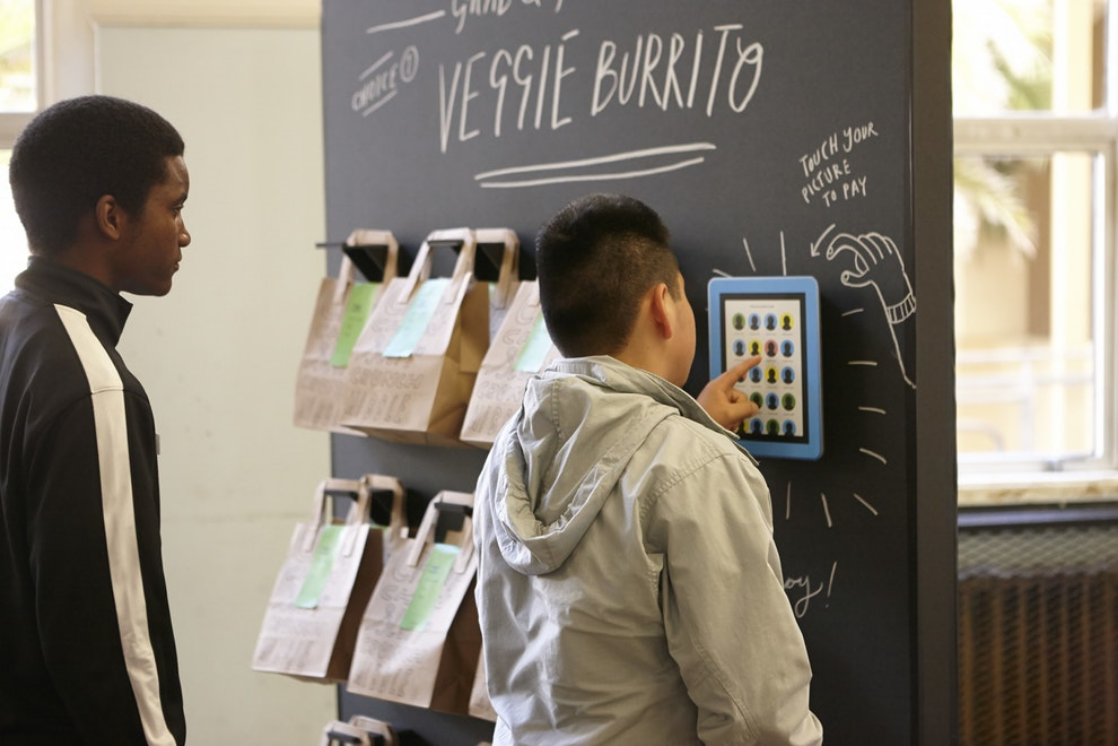
To better inform our final design concept, we collected ten exemplars of solutions already existing in our space. The one the most informed our final design came from IDEO's work with San Francisco Unified School District to design a student-centered cafeteria experience.
[ww.ideo.com/case-study/a-student-centered-cafeteria-experience]
[ww.ideo.com/case-study/a-student-centered-cafeteria-experience]
Design Visualization
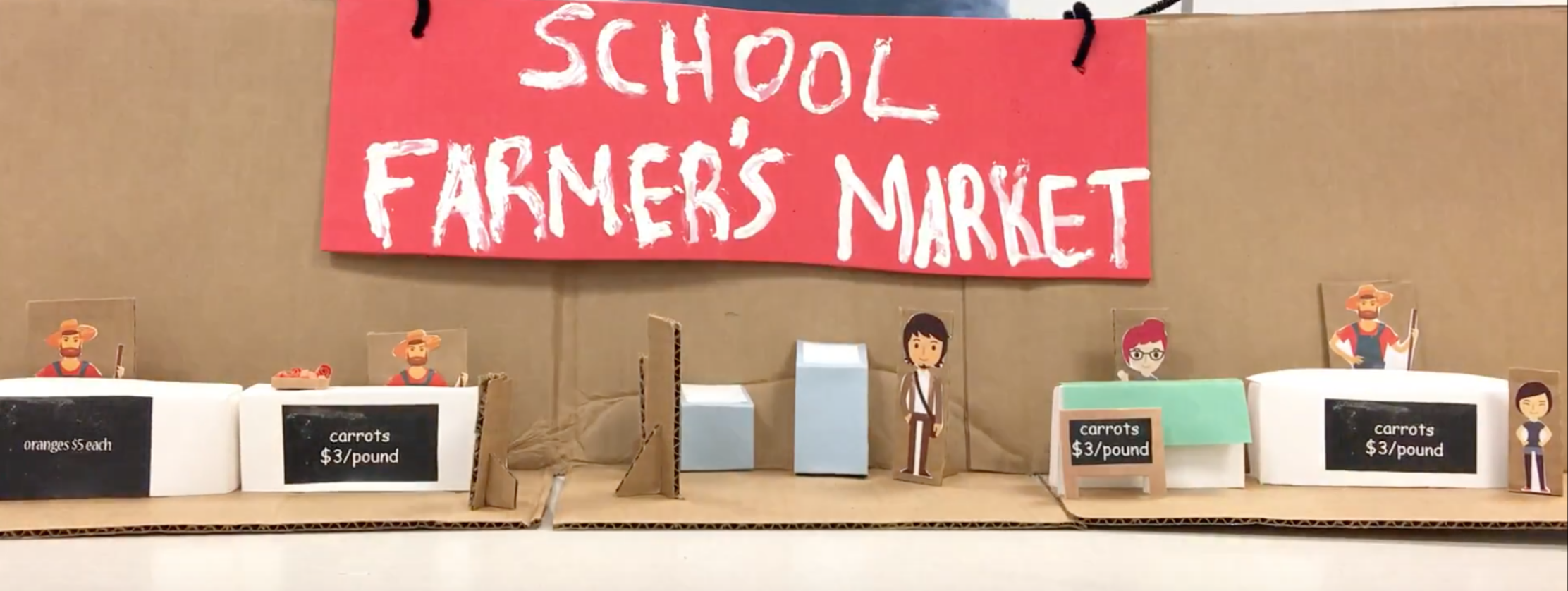
For our final design, based on the fantasy workshop following our conceptualization of our five design concepts, we decided to move forward and iterate on our idea of hosting farmer's markets directly inside of schools. To this end, we believe that having schools host the farmer's markets will not only facilitate and build relationships between farms and schools, but also build relationships between student and farmers, allowing for educational opportunities while promoting local community.
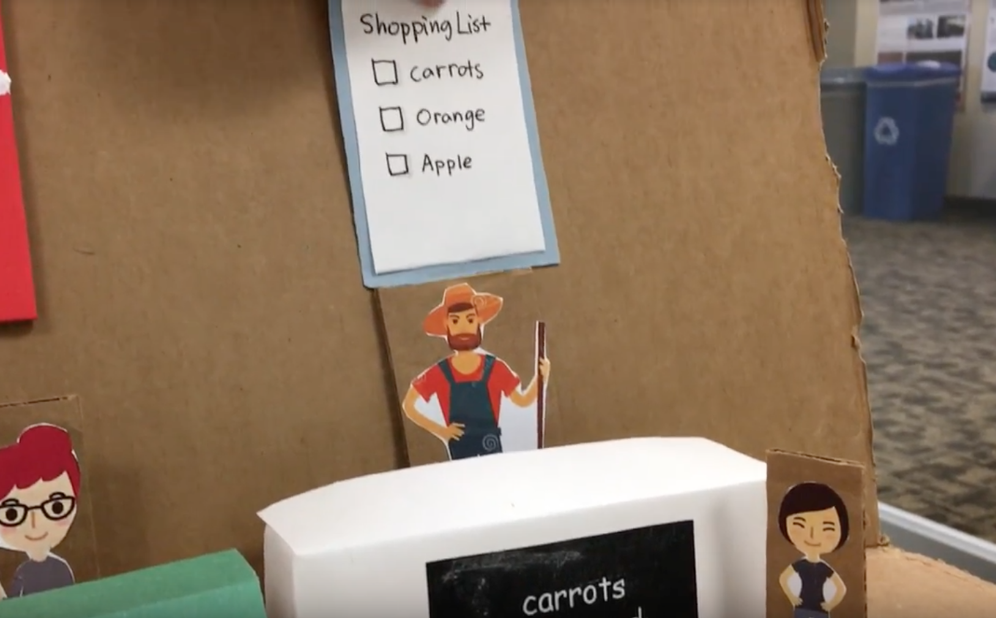
Grocery shopping for their family: While attending the farmer's market, the students would shop for produce based on familial need. This would not only allow students to consider more carefully the source and contents of what they eat at home, but also encourage discussion between family members about the importance of food source and quality.
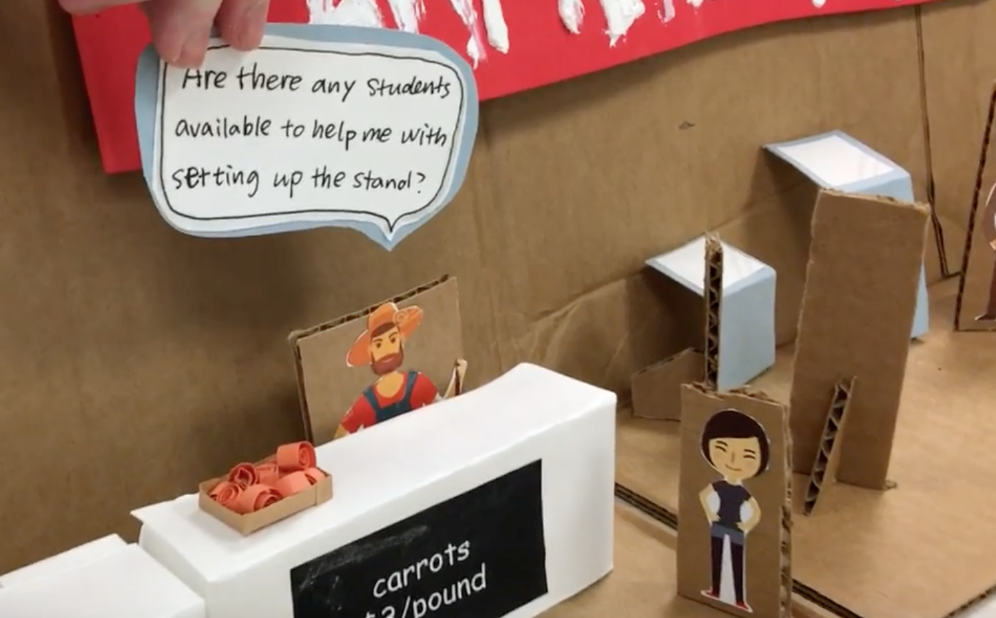
Helping farmers set up stand for farmer's market: students can volunteer to help farmers set up their respective stands to learn about the processes through which food is prepared for public consumption, as well as build relationships with local farmers.
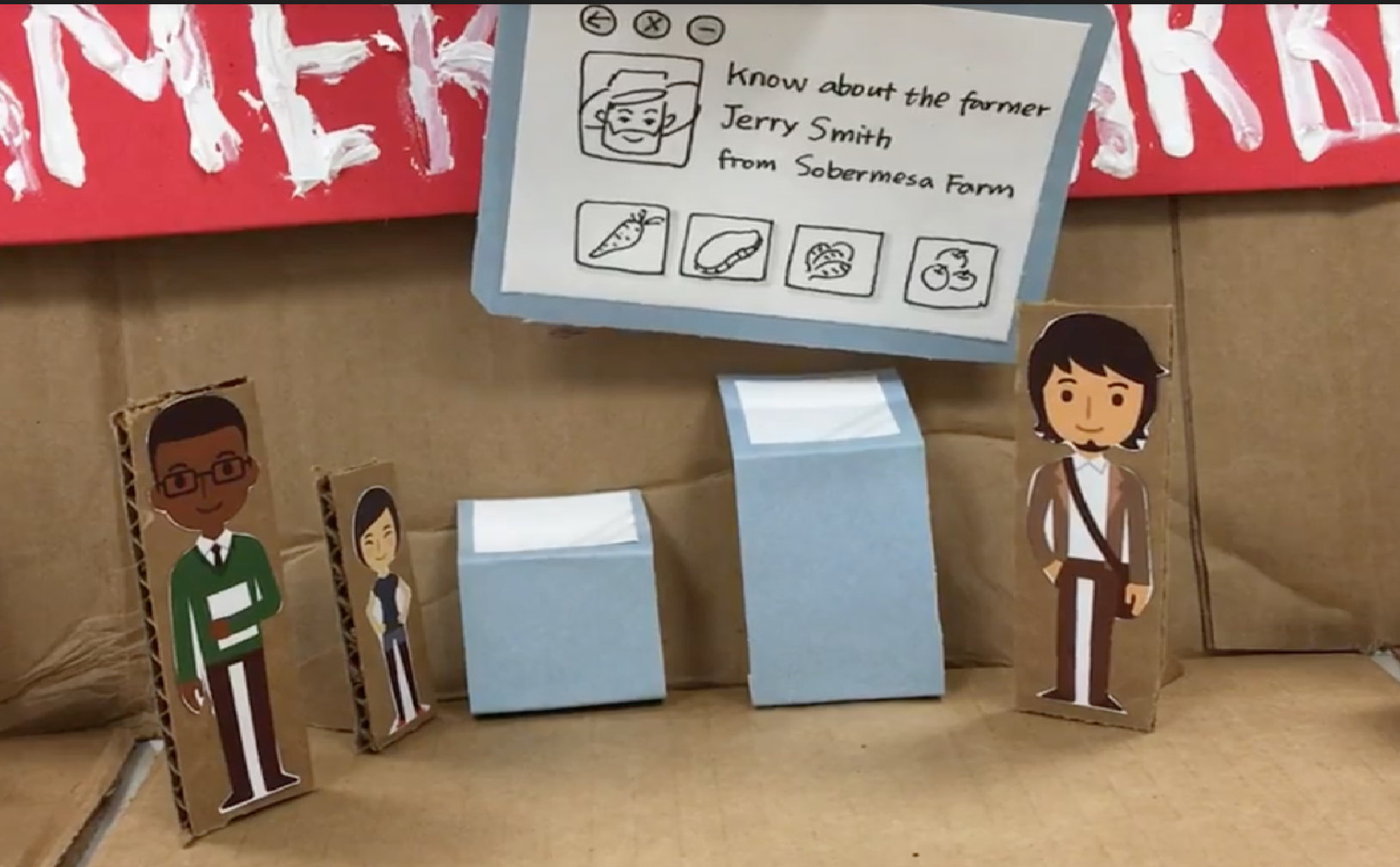
Browsing kiosk information: during the farmer's market, different locations will have tablet kiosks that will provide information about the farms attending the farmer's market such as main produces, contact information, and location. Additionally, this is another educational opportunity for the students to provide information about farming practices and philosophy at-a-glance, such as permaculture and multi-level farming.
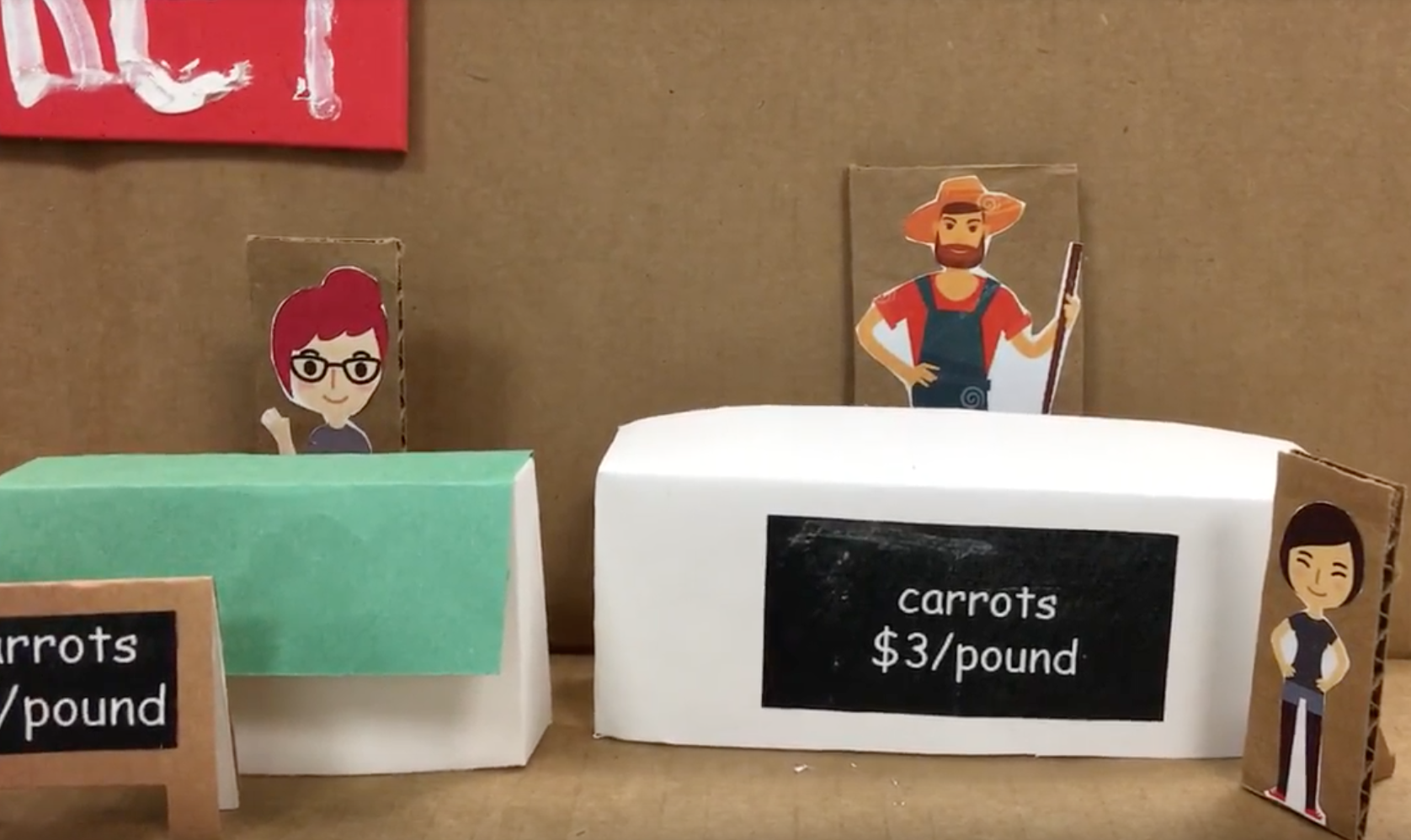
DIY Meal: Of course, as a facet of any farmer's market, food quality and consumption are focal points. Having an activity where students creating their own meals using the available ingredients from attending farms would facilitate critical thought in the students about where their food is sourced and how to balance nutritional components of their everyday meals. This activity in particular would also be supervised by teachers or parents who attend, so that students don't simply choose two apples as a meal.
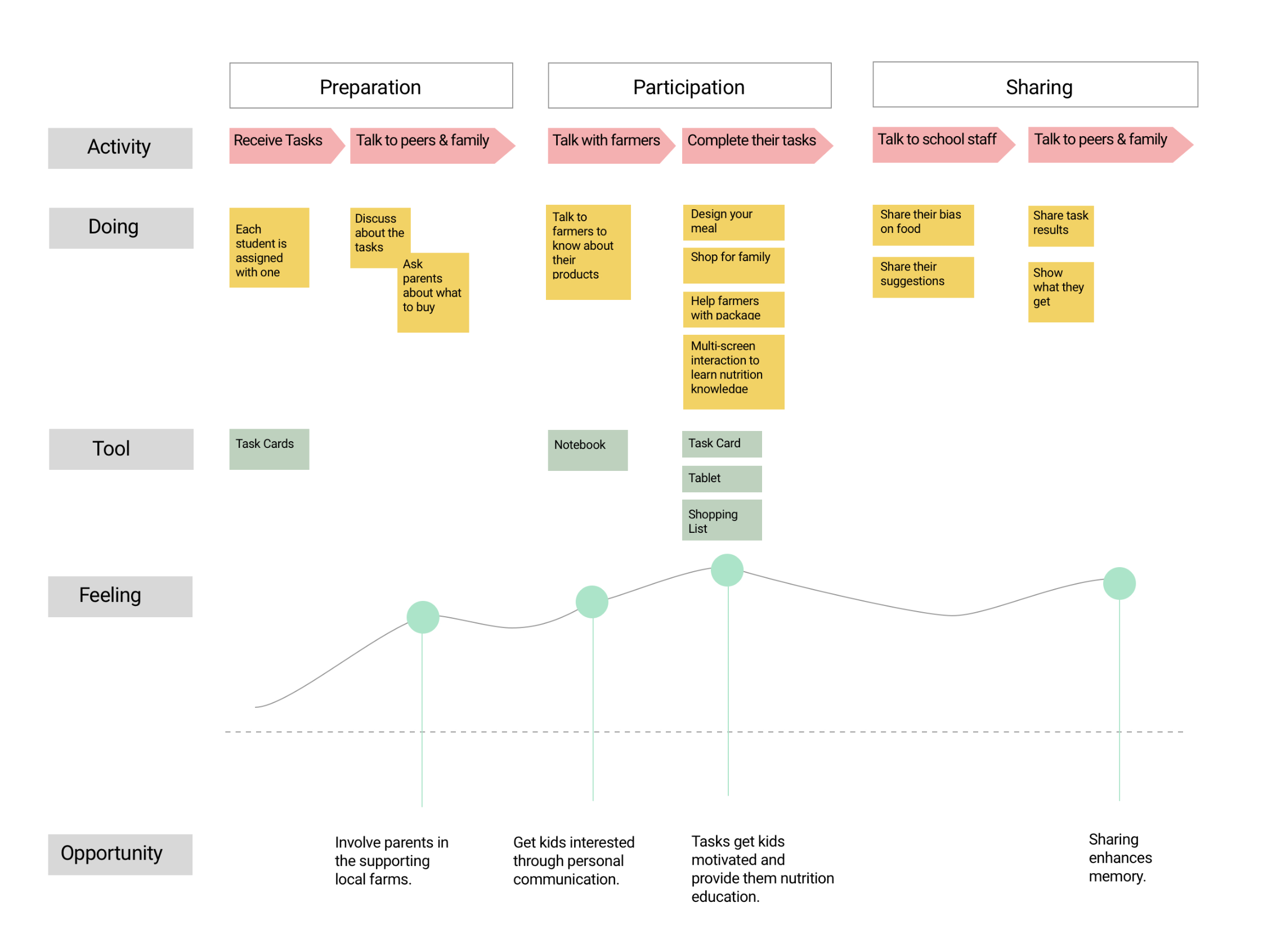
To support our designs, we created an experience map of our concept to better understand and consider the flow of the users through the farmer's market.
Reflection
What Worked?
Our research planning went really well. We were able to recruit multiple participants by the second week for interviews and workshop deployments. Additionally, given the broad nature of the prompt, we quickly and efficiently narrowed into the target problem space we wanted to explore.
What to improve for next time?
The only improvement I felt we could’ve made stemmed from the number of on-site workshops with farms. Overall, this project proved successful, and the participating farmers and school representatives asked for our findings.
![[NEEDS REVIEW] Header image for the Farm-to-School Procurement project (could not preview image to confirm content)](https://cdn.prod.website-files.com/6422638f3a9a322ac607f3a8/6433fb6c2c448e3fdfbf90b9_farm-school%20procurement%20header%20image.jpg)